Are you treating yourself to a new sweater or coat this fall? Consider donating your gently used one(s) to a worthy cause.
The 15th Annual Realtors Care blanket drive is coming up from November 30th to December 7th. All donations received in a community are given to charities within that community to distribute to low-income families and individuals, and to the homeless.
As you can imagine, with the economy having suffered so much, there are more working poor than ever who could use a helping hand. Your donation of warm, waterproof winter clothing, warm, dry socks, scarves and gloves will go a long way to help those in need.
Put a smile on the face of a struggling member of your community, and let them know that people do care. Donations will gladly be accepted at most Real estate offices during the week of November 30 - December 7th. Lists of drop off locations will be posted around your community starting in early November. Have a happy, healthy fall!
Tuesday, October 13, 2009
Thursday, September 3, 2009
Tips to Keep in Mind Between Your Mortgage Approval and Funding Dates
In light of the new market realities and tightening of credit underwriting standards by both lenders and mortgage default insurers as of late, keep in mind that now – more than ever – it’s important to be careful what you do between the time your mortgage is approved and when it funds.
A few mortgage lenders and insurers have been doing something lately that they have not done in a long time – pulling new credit bureaus prior to funding, especially if there is a long period between the time of your approval and when the mortgage actually funds.
Following are eight tips to keep in mind between your mortgage approval and funding dates:
1. Don’t buy a new car or trade-up to a more expensive lease.
2. Don’t quit your job or change jobs. Even if it’s a better-paying job, you still are likely to be on a probationary period. If in doubt, give me a call and I can let you know if this may jeopardize your approval.
3. Don’t change industries, decide to become self-employed or accept a contract position even if it’s within the same industry. Delay the start of your new job, self-employment or contract status until after the funding date of your mortgage.
4. Don’t transfer large sums of money between bank accounts. Lenders get especially skittish about this one because it looks like you’re borrowing money. Be ready to document cash transactions or money movements.
5. Don’t forget to pay your bills, even ones that you’re disputing. This can be a real deal-breaker. If the lender pulls your credit bureau prior to closing and sees a collection or a delinquent account, the best you can hope for is that they make you pay off the account before they will fund. You don’t want to have to scramble to pay off a debt at the last minute!
6. Don’t open new credit cards. Again, just wait until after your funding date.
7. Don’t accept a cash gift without properly documenting it – even if this is from proceeds of a wedding. If you have a bunch of cash to deposit before your funding date, give me a call before you deposit it.
8. Don’t buy furniture on the “Do not pay for XX years plan” until after funding. Even though you don’t have to pay now, it will still be reported on your credit bureau, and will become an issue – especially if your approval was tight to begin with.
While you may not risk losing your mortgage approval because you have broken one of these rules, it’s always best to talk to me before doing any of the above just to make sure
A few mortgage lenders and insurers have been doing something lately that they have not done in a long time – pulling new credit bureaus prior to funding, especially if there is a long period between the time of your approval and when the mortgage actually funds.
Following are eight tips to keep in mind between your mortgage approval and funding dates:
1. Don’t buy a new car or trade-up to a more expensive lease.
2. Don’t quit your job or change jobs. Even if it’s a better-paying job, you still are likely to be on a probationary period. If in doubt, give me a call and I can let you know if this may jeopardize your approval.
3. Don’t change industries, decide to become self-employed or accept a contract position even if it’s within the same industry. Delay the start of your new job, self-employment or contract status until after the funding date of your mortgage.
4. Don’t transfer large sums of money between bank accounts. Lenders get especially skittish about this one because it looks like you’re borrowing money. Be ready to document cash transactions or money movements.
5. Don’t forget to pay your bills, even ones that you’re disputing. This can be a real deal-breaker. If the lender pulls your credit bureau prior to closing and sees a collection or a delinquent account, the best you can hope for is that they make you pay off the account before they will fund. You don’t want to have to scramble to pay off a debt at the last minute!
6. Don’t open new credit cards. Again, just wait until after your funding date.
7. Don’t accept a cash gift without properly documenting it – even if this is from proceeds of a wedding. If you have a bunch of cash to deposit before your funding date, give me a call before you deposit it.
8. Don’t buy furniture on the “Do not pay for XX years plan” until after funding. Even though you don’t have to pay now, it will still be reported on your credit bureau, and will become an issue – especially if your approval was tight to begin with.
While you may not risk losing your mortgage approval because you have broken one of these rules, it’s always best to talk to me before doing any of the above just to make sure
Tuesday, August 4, 2009
The Right Specialist Gets the Job Done Right

Would you hire an electrician to do your plumbing? How about using a veterinarian to perform your own open heart surgery? Or maybe you should just do it all yourself to save money? Not a good idea. Realtors know Real Estate. And you need a Mission Realtor to market your Mission area home, to ensure you maximize your proceeds of sale.
In the Fraser Valley and Greater Vancouver area there are very distinct market trends from one area to the next. As you can see in the graph above, there are times when the average price in Mission is increasing, even as the average price in Abbotsford is decreasing, even though they are just across the bridge from each other.
Just as the recession has affected the Ontario economy more than the BC economy, market changes in one area of the Fraser Valley can be quite different than in other areas.
A Mission area specialist is in hundreds of Mission homes each month, researches values on Mission homes each day, and has experience listing and selling homes just like yours, in your area, your neighbourhood, or even on your very street.
Don't take a chance and hire the wrong person for the job. Hire your Mission area specialist, Cyndi Polovina to make sure that your home sale is a successful one!
Thursday, April 9, 2009
Our Shifting Market: Help is Needed
In a shifting market, such as we are in now, it is more important than ever that people who are considering the purchase or sale of real estate are represented by a skilled, knowledgeable Realtor who will represent their best interests.
Realtors are not merely salespeople for houses. More is needed than a knowledge of your home's value, and an ad in the paper, in order to sell your home. Many people do not realize that Realtors are trained professionals and are members of professional organizations with strict codes of ethics and guidelines on professional standards that must be maintained. There are also continuing education requirements and regular legal updates that are important to maintaining the best possible service to our clients. That is something in which I take pride. Personally, I am a member of the Fraser Valley Real Estate Board, the BCREA, and CREA. I take my obligations and agent duties to heart, and I represent my clients as I would wish to be represented if I were in their shoes.
In a market such as we are in now, which is rapidly changing, it is more important than ever to have someone looking out for your best interests. A skilled Realtor will ensure that you are protected on many levels.
One is of course to ensure that you are getting good value on your sale or purchase. Correct pricing is critical for sellers so that money is not left on the table, and it is vital to ensure that the home is priced considering market trends. That balance is very delicate, and a skilled professional can best advise you. A Realtor can also advise you of minor repairs or improvements that should be completed before listing your home. Often these minor items will pay for themselves (and then some!) Some Realtors, such as myself, may also be able to help you to stage your home to both get you the best value and sell more quickly than homes which are not staged.
As a buyer, the most important thing in a declining market is to choose a home with lasting value for you and your family. A good Realtor has knowledge of what features in homes hold value, and can also give skilled, objective advice to help you make a choice that will ensure the lasting value of your investment.
It is always the right time for certain people to buy or sell real estate. The question is whether or not now is the right time for YOU. A Realtor can help you to weigh all your options and give an objective view on the current market and on your home's value.
Furthermore, Realtors protect their clients on paper, by way of the contract, so that details such as included items and deposit monies are accounted for. If there is to be a long time before completion, or the contract is subject to the sale of the buyers' home, in a shifting market, more than ever, the Realtor must ensure their clients' interests are protected.
I would be honoured to take on the duty of representing you in your purchase or sale of real estate. Please contact me at your convenience.
Realtors are not merely salespeople for houses. More is needed than a knowledge of your home's value, and an ad in the paper, in order to sell your home. Many people do not realize that Realtors are trained professionals and are members of professional organizations with strict codes of ethics and guidelines on professional standards that must be maintained. There are also continuing education requirements and regular legal updates that are important to maintaining the best possible service to our clients. That is something in which I take pride. Personally, I am a member of the Fraser Valley Real Estate Board, the BCREA, and CREA. I take my obligations and agent duties to heart, and I represent my clients as I would wish to be represented if I were in their shoes.
In a market such as we are in now, which is rapidly changing, it is more important than ever to have someone looking out for your best interests. A skilled Realtor will ensure that you are protected on many levels.
One is of course to ensure that you are getting good value on your sale or purchase. Correct pricing is critical for sellers so that money is not left on the table, and it is vital to ensure that the home is priced considering market trends. That balance is very delicate, and a skilled professional can best advise you. A Realtor can also advise you of minor repairs or improvements that should be completed before listing your home. Often these minor items will pay for themselves (and then some!) Some Realtors, such as myself, may also be able to help you to stage your home to both get you the best value and sell more quickly than homes which are not staged.
As a buyer, the most important thing in a declining market is to choose a home with lasting value for you and your family. A good Realtor has knowledge of what features in homes hold value, and can also give skilled, objective advice to help you make a choice that will ensure the lasting value of your investment.
It is always the right time for certain people to buy or sell real estate. The question is whether or not now is the right time for YOU. A Realtor can help you to weigh all your options and give an objective view on the current market and on your home's value.
Furthermore, Realtors protect their clients on paper, by way of the contract, so that details such as included items and deposit monies are accounted for. If there is to be a long time before completion, or the contract is subject to the sale of the buyers' home, in a shifting market, more than ever, the Realtor must ensure their clients' interests are protected.
I would be honoured to take on the duty of representing you in your purchase or sale of real estate. Please contact me at your convenience.
Thursday, April 2, 2009
Fantastic Time to Buy (or Trade Up)
Qualified first-time buyers should be very pleased with themselves for not having given into the hype of the past few years and not having jumped into the market at that time. The steeply rising prices that we were experiencing, with no apparent end in sight, had many people "chomping at the bit", so to speak, to buy a home.
Ironically, with prices having come down significantly over the past year, and interest rates amazingly low, increasing affordability by leaps and bounds, there seems to be no urgency for the remaining first-time buyers to buy. But truly, now IS a great time to buy.
There seems to be a prevailing opinion among buyers that prices will continue to fall for some time. That may or may not be true. The problem with this thinking is that there is always a lag period between when the market actually starts to correct, and when it is obvious (to everyone) that the recovery has begun. (See graph). By the time that it is obvious to everyone, you will not only have lost some of your "price erosion savings", but you will lose your negotiating power.
If you are investing in real estate for the long-term (i.e. this is to be your family home for a few years to come), trying to time the bottom of the market is more or less irrelevant. If, for example, you continue to rent a few more months, while waiting for the market to drop a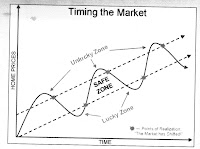 bit further, a couple of different things could happen. The market could stay the same, in which case you have thrown more rent money towards your landlord's mortgage instead of your own. The market could begin to rise, in which case you now scramble to buy (along with the others in your situation), and now find yourself in a much less powerful negotiating position. Or, in the ideal situation, the market drops another percent or even two. O.K., assuming a 2% drop, the $400,000 home is now $392,000.00. But you have spent money on rent during that time instead of paying down your mortgage for those few additional months, and what about paying yourself first? What about the stress of being "in limbo" for that much longer, not starting your new life in your new home? When you look at the affordability of that $8,000.00, with interest rates as low as they are now, you are talking about a little more than a dollar a day. For only a dollar a day more on your mortgage, you are going to put off making a move that will change your life for the better? You are going to put up with your cramped rental situation instead of moving to your dream home FOR A BUCK A DAY!??? Or, for those trading up their home, (which is lacking some bells and whistles), for their dream home, how much money are you really saving by waiting? Any savings on the home you are buying is also being sucked out of your equity in your current home as the market falls.
The bottom line is this: If you find a home that meets all or most of your criteria, that is in your price range, and it feels like a home in which you would be happy, BUY IT! Don't put it off waiting for the market to do what there are no guarantees it will do. Your dream home may not wait for you. Selection is very high now, in this buyer's market. You have a better chance of finding a suitable home now than you will once the market starts its correction. Start living now! You and I have no idea when the prices are going to start climbing back up again. There are already signs of life in the Fraser Valley Real estate market. The statistics I just viewed from the FVREB are as follows:
March 31, 2009: listings 3028, sales 1008
February 27, 2009: listings 2369, sales 682
March 31, 2008: listings 3278, sales 1317
So, as you can see, the sales activity from February to March has increased significantly, and is not far behind the 2008 numbers. The listings are actually down from March 2008 over 2009, so that creates pressure on prices as inventory levels drop (supply and demand).
This is one of the most affordable times to buy that we have seen in many years. Don't miss the boat!
I can help you to make your dreams come true. Call me to help you make the most important decision of your life an INFORMED decision.
Ironically, with prices having come down significantly over the past year, and interest rates amazingly low, increasing affordability by leaps and bounds, there seems to be no urgency for the remaining first-time buyers to buy. But truly, now IS a great time to buy.
There seems to be a prevailing opinion among buyers that prices will continue to fall for some time. That may or may not be true. The problem with this thinking is that there is always a lag period between when the market actually starts to correct, and when it is obvious (to everyone) that the recovery has begun. (See graph). By the time that it is obvious to everyone, you will not only have lost some of your "price erosion savings", but you will lose your negotiating power.
If you are investing in real estate for the long-term (i.e. this is to be your family home for a few years to come), trying to time the bottom of the market is more or less irrelevant. If, for example, you continue to rent a few more months, while waiting for the market to drop a
 bit further, a couple of different things could happen. The market could stay the same, in which case you have thrown more rent money towards your landlord's mortgage instead of your own. The market could begin to rise, in which case you now scramble to buy (along with the others in your situation), and now find yourself in a much less powerful negotiating position. Or, in the ideal situation, the market drops another percent or even two. O.K., assuming a 2% drop, the $400,000 home is now $392,000.00. But you have spent money on rent during that time instead of paying down your mortgage for those few additional months, and what about paying yourself first? What about the stress of being "in limbo" for that much longer, not starting your new life in your new home? When you look at the affordability of that $8,000.00, with interest rates as low as they are now, you are talking about a little more than a dollar a day. For only a dollar a day more on your mortgage, you are going to put off making a move that will change your life for the better? You are going to put up with your cramped rental situation instead of moving to your dream home FOR A BUCK A DAY!??? Or, for those trading up their home, (which is lacking some bells and whistles), for their dream home, how much money are you really saving by waiting? Any savings on the home you are buying is also being sucked out of your equity in your current home as the market falls.
The bottom line is this: If you find a home that meets all or most of your criteria, that is in your price range, and it feels like a home in which you would be happy, BUY IT! Don't put it off waiting for the market to do what there are no guarantees it will do. Your dream home may not wait for you. Selection is very high now, in this buyer's market. You have a better chance of finding a suitable home now than you will once the market starts its correction. Start living now! You and I have no idea when the prices are going to start climbing back up again. There are already signs of life in the Fraser Valley Real estate market. The statistics I just viewed from the FVREB are as follows:
March 31, 2009: listings 3028, sales 1008
February 27, 2009: listings 2369, sales 682
March 31, 2008: listings 3278, sales 1317
So, as you can see, the sales activity from February to March has increased significantly, and is not far behind the 2008 numbers. The listings are actually down from March 2008 over 2009, so that creates pressure on prices as inventory levels drop (supply and demand).
This is one of the most affordable times to buy that we have seen in many years. Don't miss the boat!
I can help you to make your dreams come true. Call me to help you make the most important decision of your life an INFORMED decision.


Tuesday, October 7, 2008
Housing Market Update
I just read a very sound report from Scotiabank Group titled "Special Update: Canadian Mortgages". It supports what was reported on the local news last week. The newscasters had interviewed Cameron Muir from the BCREA and a couple of local Realtors. One of the conclusions was that prices have dropped about 5% so far in the last six months, and we may expect up to the same amount again over the next 6 months to a year. The Scotiabank Group report speaks of "further fairly modest erosion of house prices." So, without putting a number on it, they are saying that prices will continue to decline a little bit for the next little while.
While I do not have a crystal ball to predict the future, I am presently of the opinion that a lot of the price drops in the last six months have been due to the fear factor, not sound economics. No one really knows how much the U.S. slowdown will affect our economy and Buyers are afraid to make the wrong decision. Perhaps they are afraid to buy a first home before the market bottom comes, thus paying too much, or afraid to get a mortgage on a home and then lose their income. So, a lot of people are in the "wait and see" mindset. The activity that we continue to experience in the market is from people who are not easily scared off by the media hype, or people who cannot afford to wait due to a change in their circumstances.
With the bailout package in the U.S. having just been put in place, it will take some time to see how much success it has to rescue the U.S. from a serious recession, or even a depression. Depending on the severity of the problems in the U.S., B.C. may not see much of a decline in the economy, since our economy is in some ways more insulated from the U.S. effect (due to fewer manufacturing jobs, more exports to Asia). We will definitely fare better than many other Canadian provinces will.
I believe that there are only two changes that are possible come the spring - either it will become clear that our economy has definitely declined and many people are losing their jobs, which will cause house prices to drop even further, or people will start to realize that our economy will weather this storm, and housing prices will start to rebound. I am optimistic that prices will rebound sooner, rather than later.
I believe that much of the media hype is just that - "hype" - and that time will tell how much our economy will withstand this. I believe that prices are not going to erode for very long, and agree with the experts that price drops will be slow and gradual.
For buyers there are still many reasons that now is the right time to buy. If they sit and wait, they may have less selection, and in the mean time, how many rent payments will they have thrown away? There are many homes that are fantastic steals due to divorces or job transfers forcing a quick sale, and there are definitely many deals to be had in this strong buyers' market. The options and inventory are abundant, so finding your dream home, with all the options and features that you want, is easier than it has been in years.
Also, for sellers, now is a great time to make an upward move, or perhaps to shorten your commute. If you have been wanting that extra bedroom or that larger lot, or to move closer to Vancouver, you can't lose right now. Any declines in your home's value have most likely been more than offset by the declines in the price of the bigger home, or the one closer to town.
Also, in a strong sellers' market, many sellers were tempted to buy first - writing an offer subject to the sale of their home. This is not a recommended practice because it generally costs you more money overall, but many people do it so they ensure they won't end up with nothing appropriate to buy, (with the slim pickings of a seller's market), and to be forced to rent until something appropriate comes available, meaning they have to move twice. With the buyers' market we are in, you can be sure that with the inventory levels we currently have, only the pickiest people will be hard-pressed to find a suitable home to buy. That leaves you free to sell your home before making an offer on a home to purchase, keeping more money in your pockets.
If I can be of service to you in the Mission or Abbotsford area, or if you need a referral to one of my colleagues in your area, please do not hesitate to contact me. My information is in the side panel. Have a safe and happy October!
While I do not have a crystal ball to predict the future, I am presently of the opinion that a lot of the price drops in the last six months have been due to the fear factor, not sound economics. No one really knows how much the U.S. slowdown will affect our economy and Buyers are afraid to make the wrong decision. Perhaps they are afraid to buy a first home before the market bottom comes, thus paying too much, or afraid to get a mortgage on a home and then lose their income. So, a lot of people are in the "wait and see" mindset. The activity that we continue to experience in the market is from people who are not easily scared off by the media hype, or people who cannot afford to wait due to a change in their circumstances.
With the bailout package in the U.S. having just been put in place, it will take some time to see how much success it has to rescue the U.S. from a serious recession, or even a depression. Depending on the severity of the problems in the U.S., B.C. may not see much of a decline in the economy, since our economy is in some ways more insulated from the U.S. effect (due to fewer manufacturing jobs, more exports to Asia). We will definitely fare better than many other Canadian provinces will.
I believe that there are only two changes that are possible come the spring - either it will become clear that our economy has definitely declined and many people are losing their jobs, which will cause house prices to drop even further, or people will start to realize that our economy will weather this storm, and housing prices will start to rebound. I am optimistic that prices will rebound sooner, rather than later.
I believe that much of the media hype is just that - "hype" - and that time will tell how much our economy will withstand this. I believe that prices are not going to erode for very long, and agree with the experts that price drops will be slow and gradual.
For buyers there are still many reasons that now is the right time to buy. If they sit and wait, they may have less selection, and in the mean time, how many rent payments will they have thrown away? There are many homes that are fantastic steals due to divorces or job transfers forcing a quick sale, and there are definitely many deals to be had in this strong buyers' market. The options and inventory are abundant, so finding your dream home, with all the options and features that you want, is easier than it has been in years.
Also, for sellers, now is a great time to make an upward move, or perhaps to shorten your commute. If you have been wanting that extra bedroom or that larger lot, or to move closer to Vancouver, you can't lose right now. Any declines in your home's value have most likely been more than offset by the declines in the price of the bigger home, or the one closer to town.
Also, in a strong sellers' market, many sellers were tempted to buy first - writing an offer subject to the sale of their home. This is not a recommended practice because it generally costs you more money overall, but many people do it so they ensure they won't end up with nothing appropriate to buy, (with the slim pickings of a seller's market), and to be forced to rent until something appropriate comes available, meaning they have to move twice. With the buyers' market we are in, you can be sure that with the inventory levels we currently have, only the pickiest people will be hard-pressed to find a suitable home to buy. That leaves you free to sell your home before making an offer on a home to purchase, keeping more money in your pockets.
If I can be of service to you in the Mission or Abbotsford area, or if you need a referral to one of my colleagues in your area, please do not hesitate to contact me. My information is in the side panel. Have a safe and happy October!
Thursday, July 17, 2008
A Market Shift = A Shift In Expectations
Market conditions have shifted. After five years of blockbuster activity and double-digit price growth, market conditions have slowed, and now favour buyers in many areas of the province.
Residential sales have declined 22 per cent in the first six months of this year, while available resale inventory has grown by 54 per cent to 57,000 active listings in June. In the Greater Vancouver board area, where longer-term data is available, inventory is at the highest level since 1998.
Home price appreciation observed from 2004 to 2007 is less attainable in today’s market, and sellers’ expectations for such gains should be tempered. More generally, in a market favouring buyers, prices generally increase at or below the level of inflation. While the average residential home price in BC increased at a healthy 6 per cent per year since 1981, large gains are often followed by periods of price stagnation. Over-optimistic pricing by sellers will only inhibit the timely sale of properties, adding to inventory levels.
Buyers have more homes to choose from now than in previous years, resulting in greater freedom to compare the attributes and prices of similar properties in the market before making purchase decisions.
Despite current buyers' market conditions fuelled by housing affordability constraints and economic uncertainty, the economic and demographic backdrop in support of housing demand remains strong in BC. BC's unemployment rate remains near record lows, while the labour force participation rate hovers near historical highs. Meanwhile, the province remains a favoured destination for new migrants, reflected in the third-highest population growth among provinces during the first quarter of 2008. However, challenges continue in the forestry sector, and eroded consumer confidence may also be playing a role in a pull back of consumer spending.
Copyright British Columbia Real Estate Association. Reprinted with permission. BCREA makes no guarantees as to the accuracy or completeness of this information.
Residential sales have declined 22 per cent in the first six months of this year, while available resale inventory has grown by 54 per cent to 57,000 active listings in June. In the Greater Vancouver board area, where longer-term data is available, inventory is at the highest level since 1998.
Home price appreciation observed from 2004 to 2007 is less attainable in today’s market, and sellers’ expectations for such gains should be tempered. More generally, in a market favouring buyers, prices generally increase at or below the level of inflation. While the average residential home price in BC increased at a healthy 6 per cent per year since 1981, large gains are often followed by periods of price stagnation. Over-optimistic pricing by sellers will only inhibit the timely sale of properties, adding to inventory levels.
Buyers have more homes to choose from now than in previous years, resulting in greater freedom to compare the attributes and prices of similar properties in the market before making purchase decisions.
Despite current buyers' market conditions fuelled by housing affordability constraints and economic uncertainty, the economic and demographic backdrop in support of housing demand remains strong in BC. BC's unemployment rate remains near record lows, while the labour force participation rate hovers near historical highs. Meanwhile, the province remains a favoured destination for new migrants, reflected in the third-highest population growth among provinces during the first quarter of 2008. However, challenges continue in the forestry sector, and eroded consumer confidence may also be playing a role in a pull back of consumer spending.
Copyright British Columbia Real Estate Association. Reprinted with permission. BCREA makes no guarantees as to the accuracy or completeness of this information.
Subscribe to:
Posts (Atom)