I just read this article at:
http://www.canadianmortgagetrends.com/canadian_mortgage_trends/2011/01/top-10-effects-of-the-new-mortgage-rules.html
Very interesting predictions, indeed. The most interesting, and likely, in my opinion are these two:
1) A small portion of home buyers will sprint to buy homes with a 35-year amortization before March 18, followed by downward pressure on home prices after March 18 as the amortization reduction removes market liquidity
2) If amortization restrictions accelerate falling home prices, we’ll see somewhat greater default risk and more negative equity situations among low-equity homeowners
The bottom line for most people deciding whether or not now is the right time to buy or sell is their life situation. People with job transfers, experiencing divorce, with a growing family, or who are empty-nesters, will buy and/or sell without worrying about what the market is doing, assuming that they have the ability to do so. The mortgage qualifying changes may reduce the ability of a portion of the population to buy, which could have a negative effect on prices.
If you need help in analyzing current market trends, in order to help you with your decision to buy or sell, please give me a call. I'd be happy to help!
Tuesday, January 25, 2011
Wednesday, January 19, 2011
What's Affecting Your Credit Score?
I just read this article at:
http://www.financialpost.com/personal-finance/What+affecting+your+credit+score/4126038/story.html
It isn't something that most people think about very often, but it becomes very important when you are applying for a mortgage on a house. There are a number of factors that affect your credit score, not just whether or not you generally pay your bills in full and on time.
I am not a financial advisor, and it could be misinformation, but I actually also heard recently that even if you pay your bills on the due date, your credit score wouldn't be as good as it would be if you paid it as soon as you receive it.
As the article explains, having too many credit cards can be a bad thing, but having too few can also be bad:
"Your utilization of credit is also a major factor — that’s your balance divided by available credit. It’s not based on whether you have a balance at the end of the month but it’s the balance outstanding at a given moment divided by your available credit.
“If that number exceeds 40%, that is typically a warning sign,” says Mr. Reid, noting a higher credit limit will keep that percentage down.
The last factors are longer term credit history and the breadth of your credit, somebody who has just one credit card doesn’t look as strong as someone who also has a line of credit and say a mortgage." click the link to see the whole article by Garry Marr, Financial Post · Tuesday, Jan. 18, 2011. (Read more: http://www.financialpost.com/personal-finance/What+affecting+your+credit+score/4126038/story.html#ixzz1C642R7KB.)
http://www.financialpost.com/personal-finance/What+affecting+your+credit+score/4126038/story.html
It isn't something that most people think about very often, but it becomes very important when you are applying for a mortgage on a house. There are a number of factors that affect your credit score, not just whether or not you generally pay your bills in full and on time.
I am not a financial advisor, and it could be misinformation, but I actually also heard recently that even if you pay your bills on the due date, your credit score wouldn't be as good as it would be if you paid it as soon as you receive it.
As the article explains, having too many credit cards can be a bad thing, but having too few can also be bad:
"Your utilization of credit is also a major factor — that’s your balance divided by available credit. It’s not based on whether you have a balance at the end of the month but it’s the balance outstanding at a given moment divided by your available credit.
“If that number exceeds 40%, that is typically a warning sign,” says Mr. Reid, noting a higher credit limit will keep that percentage down.
The last factors are longer term credit history and the breadth of your credit, somebody who has just one credit card doesn’t look as strong as someone who also has a line of credit and say a mortgage." click the link to see the whole article by Garry Marr, Financial Post · Tuesday, Jan. 18, 2011. (Read more: http://www.financialpost.com/personal-finance/What+affecting+your+credit+score/4126038/story.html#ixzz1C642R7KB.)
Tuesday, January 18, 2011
Changes Made To Ensure Long-Term Stability of Canada’s Housing Market
On January 17, 2011, the Honourable Jim Flaherty, Minister of Finance, and the Honourable Christian Paradis, Minister of Natural Resources, announced prudent adjustments to the rules for government-backed insured mortgages to support the long-term stability of Canada’s housing market.
“Canada’s well-regulated housing sector has been an important strength that allowed us to avoid the mistakes of other countries and helped protect us from the worst of the recent global recession,” said Minister Flaherty. “The prudent measures announced today build on that advantage by encouraging hard-working Canadian families to save by investing in their homes and future.”
“The economy continues to be our Government’s top priority,” continued Minister Paradis. “Our Government will continue to take the necessary actions to ensure stability and economic certainty in Canada’s housing market.”
The new measures:
Reduce the maximum amortization period to 30 years from 35 years for new government- backed insured mortgages with loan-to-value ratios of more than 80 per cent. This will significantly reduce the total interest payments Canadian families make on their mortgages, allow Canadian families to build up equity in their homes more quickly, and help Canadians pay off their mortgages before they retire.
Lower the maximum amount Canadians can borrow in refinancing their mortgages to 85 per cent from 90 per cent of the value of their homes. This will promote saving through home ownership and limit the repackaging of consumer debt into mortgages guaranteed by taxpayers.
Withdraw government insurance backing on lines of credit secured by homes, such as home equity lines of credit, or HELOCs. This will ensure that risks associated with consumer debt products used to borrow funds unrelated to house purchases are managed by the financial institutions and not borne by taxpayers.
Our Government’s ongoing monitoring and sound underlying supervisory regime, along with the traditionally cautious approach taken by Canadian financial institutions to mortgage lending, have allowed Canada to maintain strong and secure housing and mortgage markets.
The adjustments to the mortgage insurance guarantee framework will come into force on March 18, 2011. The withdrawal of government insurance backing on lines of credit secured by homes will come into force on April 18, 2011.
In order for a person to be able to obtain a 35-year amortization, they would have had to have been prequalified with a lender prior to the announcement and they will have to have a firm (non-subject) offer in place on a home, with a lending comittment in hand by March 17th, 2011.
“Canada’s well-regulated housing sector has been an important strength that allowed us to avoid the mistakes of other countries and helped protect us from the worst of the recent global recession,” said Minister Flaherty. “The prudent measures announced today build on that advantage by encouraging hard-working Canadian families to save by investing in their homes and future.”
“The economy continues to be our Government’s top priority,” continued Minister Paradis. “Our Government will continue to take the necessary actions to ensure stability and economic certainty in Canada’s housing market.”
The new measures:
Reduce the maximum amortization period to 30 years from 35 years for new government- backed insured mortgages with loan-to-value ratios of more than 80 per cent. This will significantly reduce the total interest payments Canadian families make on their mortgages, allow Canadian families to build up equity in their homes more quickly, and help Canadians pay off their mortgages before they retire.
Lower the maximum amount Canadians can borrow in refinancing their mortgages to 85 per cent from 90 per cent of the value of their homes. This will promote saving through home ownership and limit the repackaging of consumer debt into mortgages guaranteed by taxpayers.
Withdraw government insurance backing on lines of credit secured by homes, such as home equity lines of credit, or HELOCs. This will ensure that risks associated with consumer debt products used to borrow funds unrelated to house purchases are managed by the financial institutions and not borne by taxpayers.
Our Government’s ongoing monitoring and sound underlying supervisory regime, along with the traditionally cautious approach taken by Canadian financial institutions to mortgage lending, have allowed Canada to maintain strong and secure housing and mortgage markets.
The adjustments to the mortgage insurance guarantee framework will come into force on March 18, 2011. The withdrawal of government insurance backing on lines of credit secured by homes will come into force on April 18, 2011.
In order for a person to be able to obtain a 35-year amortization, they would have had to have been prequalified with a lender prior to the announcement and they will have to have a firm (non-subject) offer in place on a home, with a lending comittment in hand by March 17th, 2011.
Friday, December 31, 2010
Top Ten Home Staging Ideas
For many homeowners, the concept of professional home staging is shedding new light on how to promote a home in their real estate marketplace. If you’re thinking of selling your home, deciding on the best ways to organize your property before the “For Sale” sign is erected can help sell your home. Following are some tips that may help you sell your home faster and at a higher price.
1. Make a great first impression. Prospective buyers make up their minds about your house even before they get out of the car. To ensure they have the right idea, clean up your yard, get rid of unsightly weeds, and sweep/shovel your driveway and porches. Get out the rags and cleanser and spend 30 minutes scouring your front door, porch, railings and steps. Then tuck away all your recycling cans and bins at the back of the house or in a corner of the garage.
2. Declutter. A common phrase used to describe the importance of decluttering is: Clutter eats equity. So purge your closets, empty cupboards and box up small appliances. You may even want to rent a storage locker to keep items you simply cannot part with, while throwing out items you’ve collected over the years that you don’t want to take with you to your next home. This will also save you time during your big move. Ensure you pay close attention to your countertops and coffee tables as well.
3. Impersonal works. You want buyers to imagine themselves living in your home, so stash anything connected to your family or personal interests. Hide your son’s hockey trophies, store family photos and remove all traces of day-to-day life. This also included removing personal effects from the bathrooms.
4. Keep it fresh. There’s nothing worse than stepping into a house that smells of smoke, dampness or pet odours. The easy solution is to keep your windows open for 10 minutes a day. This strategy works better than deodorizers since a lot of people have allergies to artificial room fresheners. The oldest trick of all? Leave chocolate chip cookies baking in the oven. Yes, it’s hokey, but the smell does do wonders to help buyers bond with your home.
5. Declare war on grime. Cleanliness helps put a buyer’s mind at ease since it suggests that you’ve probably taken good care of your residence in other ways as well. So clean everything: walls, door handles, light fixtures and pantry cupboards. And don’t forget to dust your furnace room and furnace, since this makes your furnace look newer. Power washing windows, walkways, eavestroughs and pathways can also do wonders for your home’s exterior.
6. Hire a handyman. If you don’t have the time or expertise to deal with the aesthetics of your home, consider hiring a professional. Dripping faucets, cracked tiles and mouldy caulking around the bathtub can knock thousands of dollars off the price of your home.
7. Colour it up. Your single best investment may be a fresh coat of paint in key areas of your home. Try painting your front door and placing some urns containing seasonal arrangements on your front step or just inside the entryway. Remember that small touches can make a house seem cared for and important.
8. Reduce furniture. An easy way to create a sense of space is to get rid of some furniture. Moving a sofa and end tables into storage can give a small room some much-needed breathing space. If your furniture dates from the Mulroney era, consider packing it away and renting or borrowing some modern, stylish furniture or a couple of well-chosen pieces of wall art. Keep your rooms clean and simple like a hotel room or the showroom for a new house.
9. Lighten up. The brighter and sunnier a space, the easier it is to sell. If you don’t have the time or energy to clean all of your windows – inside and out – it may be a wise investment to hire a professional window-cleaning company. Thoroughly clean the shades on your light fixtures, change light bulbs and add floor lamps if an area seems dim. Finally, when it comes time to show your home, make sure all the lights are on, especially in hallways.
10. Add a touch of humanity. A couple of planters containing seasonal arrangements on your front porch, a vase of flowers on your dining room table, or even a simple rose in a vase can warm up a room. Candles can also do wonders in lighting and warming a room.
It used to be a good idea to stage a home. It set your home apart from the majority of other homes on the market which were not staged. Nowadays, with all the magazines and television programs aimed at this industry, it is almost a necessity.
I would be happy to help walk through your Mission or Abbotsford home to give you specific hints to prepare for helping you get it sold for the most money in the shortest time!
1. Make a great first impression. Prospective buyers make up their minds about your house even before they get out of the car. To ensure they have the right idea, clean up your yard, get rid of unsightly weeds, and sweep/shovel your driveway and porches. Get out the rags and cleanser and spend 30 minutes scouring your front door, porch, railings and steps. Then tuck away all your recycling cans and bins at the back of the house or in a corner of the garage.
2. Declutter. A common phrase used to describe the importance of decluttering is: Clutter eats equity. So purge your closets, empty cupboards and box up small appliances. You may even want to rent a storage locker to keep items you simply cannot part with, while throwing out items you’ve collected over the years that you don’t want to take with you to your next home. This will also save you time during your big move. Ensure you pay close attention to your countertops and coffee tables as well.
3. Impersonal works. You want buyers to imagine themselves living in your home, so stash anything connected to your family or personal interests. Hide your son’s hockey trophies, store family photos and remove all traces of day-to-day life. This also included removing personal effects from the bathrooms.
4. Keep it fresh. There’s nothing worse than stepping into a house that smells of smoke, dampness or pet odours. The easy solution is to keep your windows open for 10 minutes a day. This strategy works better than deodorizers since a lot of people have allergies to artificial room fresheners. The oldest trick of all? Leave chocolate chip cookies baking in the oven. Yes, it’s hokey, but the smell does do wonders to help buyers bond with your home.
5. Declare war on grime. Cleanliness helps put a buyer’s mind at ease since it suggests that you’ve probably taken good care of your residence in other ways as well. So clean everything: walls, door handles, light fixtures and pantry cupboards. And don’t forget to dust your furnace room and furnace, since this makes your furnace look newer. Power washing windows, walkways, eavestroughs and pathways can also do wonders for your home’s exterior.
6. Hire a handyman. If you don’t have the time or expertise to deal with the aesthetics of your home, consider hiring a professional. Dripping faucets, cracked tiles and mouldy caulking around the bathtub can knock thousands of dollars off the price of your home.
7. Colour it up. Your single best investment may be a fresh coat of paint in key areas of your home. Try painting your front door and placing some urns containing seasonal arrangements on your front step or just inside the entryway. Remember that small touches can make a house seem cared for and important.
8. Reduce furniture. An easy way to create a sense of space is to get rid of some furniture. Moving a sofa and end tables into storage can give a small room some much-needed breathing space. If your furniture dates from the Mulroney era, consider packing it away and renting or borrowing some modern, stylish furniture or a couple of well-chosen pieces of wall art. Keep your rooms clean and simple like a hotel room or the showroom for a new house.
9. Lighten up. The brighter and sunnier a space, the easier it is to sell. If you don’t have the time or energy to clean all of your windows – inside and out – it may be a wise investment to hire a professional window-cleaning company. Thoroughly clean the shades on your light fixtures, change light bulbs and add floor lamps if an area seems dim. Finally, when it comes time to show your home, make sure all the lights are on, especially in hallways.
10. Add a touch of humanity. A couple of planters containing seasonal arrangements on your front porch, a vase of flowers on your dining room table, or even a simple rose in a vase can warm up a room. Candles can also do wonders in lighting and warming a room.
It used to be a good idea to stage a home. It set your home apart from the majority of other homes on the market which were not staged. Nowadays, with all the magazines and television programs aimed at this industry, it is almost a necessity.
I would be happy to help walk through your Mission or Abbotsford home to give you specific hints to prepare for helping you get it sold for the most money in the shortest time!
Thursday, December 30, 2010
BCREA Mortgage Rate Forecast
The unexpected rise in yields prompted a fairly dramatic re-pricing of mortgages in November. After falling to an all-time low of 5.19%, the 5-year mortgage rate has leapt 25bps to 5.44% while the 1-year rate increased from 3.20% to 3.35%.
Heightened volatility in bond markets could mean a re-testing of mortgage rates lows, particularly if a deepening Euro-crisis prompts a flight to safety in US and Canadian treasuries.
A more likely outcome is that mortgage rates will stay flat for the next quarter as investors re-evaluate growth and inflation expectations in the context of a QE2 world. Our expectation for 2011 is that rates will begin a slow march upwards, hovering slightly higher than current levels for the first half of 2011. Rates will then be prompted higher by expectations of renewed, but cautious, rate tightening by the Bank of Canada in the second half of next year.
The BCREA forecast for the 1-year mortgage rate to average 3.3% in 4th quarter of 2010 and to reach 4.4% by the end of 2011. The 5-year fixed mortgage rate will average 5.30% for the 4th quarter of 2010 before increasing to 5.90% in 2011.
For the full report, go to: http://www.bcrea.bc.ca/economics/forecasts/MortgageRateForecast.pdf
Heightened volatility in bond markets could mean a re-testing of mortgage rates lows, particularly if a deepening Euro-crisis prompts a flight to safety in US and Canadian treasuries.
A more likely outcome is that mortgage rates will stay flat for the next quarter as investors re-evaluate growth and inflation expectations in the context of a QE2 world. Our expectation for 2011 is that rates will begin a slow march upwards, hovering slightly higher than current levels for the first half of 2011. Rates will then be prompted higher by expectations of renewed, but cautious, rate tightening by the Bank of Canada in the second half of next year.
The BCREA forecast for the 1-year mortgage rate to average 3.3% in 4th quarter of 2010 and to reach 4.4% by the end of 2011. The 5-year fixed mortgage rate will average 5.30% for the 4th quarter of 2010 before increasing to 5.90% in 2011.
For the full report, go to: http://www.bcrea.bc.ca/economics/forecasts/MortgageRateForecast.pdf
Sunday, August 15, 2010
10 Worst First-time Homebuyer Mistakes
According to a recent story in the Globe and Mail, (the full article can be viewed at:
http://www.theglobeandmail.com/globe-investor/personal-finance/10-worst-first-time-homebuyer-mistakes/article1647390/), there are 10 things a first-time buyer should avoid to maximize their success:
10) Not thinking about the future
9) Not choosing to hire a REALTOR®
8) Neglecting to inspect
7) Compromising on the important things
6) Being swept away
5) Lacking vision
4) Being too picky
3) Failing to consider additional expenses
2) Skipping mortgage qualification
and #1 - Not knowing what you can Afford
While it's good to familiarize yourself with Real estate procedures and tips, working with a professional Realtor® can help you to maximize your chances of success on your purchase. I can guide you through the process to make sure no important steps or information are missed. My specialty is helping buyers and sellers in Mission and Abbotsford save money and make educated decisions based on their wants and needs, combined with the current state of the local market.
Just as doctors know medicine, accountants know taxes, and mechanics know engines, REALTORS® know real estate. Your purchase or sale of homes and property is most likely to be successful with professional help.
http://www.theglobeandmail.com/globe-investor/personal-finance/10-worst-first-time-homebuyer-mistakes/article1647390/), there are 10 things a first-time buyer should avoid to maximize their success:
10) Not thinking about the future
9) Not choosing to hire a REALTOR®
8) Neglecting to inspect
7) Compromising on the important things
6) Being swept away
5) Lacking vision
4) Being too picky
3) Failing to consider additional expenses
2) Skipping mortgage qualification
and #1 - Not knowing what you can Afford
While it's good to familiarize yourself with Real estate procedures and tips, working with a professional Realtor® can help you to maximize your chances of success on your purchase. I can guide you through the process to make sure no important steps or information are missed. My specialty is helping buyers and sellers in Mission and Abbotsford save money and make educated decisions based on their wants and needs, combined with the current state of the local market.
Just as doctors know medicine, accountants know taxes, and mechanics know engines, REALTORS® know real estate. Your purchase or sale of homes and property is most likely to be successful with professional help.
Saturday, August 7, 2010
Buyers on the Beach?

We have had a beautiful summer so far. Based on market data, it seems that many people are getting out and enjoying it, rather than looking at MLS listings and going to view homes with their REALTORS®.
July 2010 sales in the Fraser Valley Real Estate Board (FVREB) area were the lowest July sales recorded in the past decade. Besides the weather enticing buyers away, the slow July in real estate sales is probably also due to a combination of other factors. Misunderstanding and fears about the newly adopted HST, combined with recent interest rate hikes, as well as tightening in April of mortgage lending requirements are my main suspects for the activity slow-down.
Thankfully, for those of us living in Mission, our beautiful District did not fair as badly as some other areas in the FVREB. Year-over-year, Mission's sales of residential detached (RED) homes were only down 33.3% compared to -47.3% in the FVREB. Comparing sales of RED homes in June 2010 vs. July 2010, the FVREB showed -39.3% compared to Mission's -27.6%.
Mission homeowners will be happiest with the benchmark pricing stats. The housing price index of a benchmark RED home in the FVREB declined 1.5%, while in Mission we actually registered a month-over month gain of 1.8%.
Large differences in sales trends often occur in the various areas of the FVREB. It is therefore very important to enlist the help of a local REALTOR®, who understands the area's current market trends, when you are considering the sale or purchase of a home. It is with the help and expertise of a Mission area real estate expert, like myself, that you will ensure a successful real estate transaction on the purchase or sale of a Mission property.
Sunday, June 6, 2010
MANAGING THE STRESSES OF BUYING AND SELLING A HOME
By Stanley Popovich, guest blogger
Many people deal with the anxieties of buying or selling a home. This process can be confusing to many people. As a result, here is a list of ways that a person can use to manage the anxiety of purchasing or selling a home.
The first step is to determine your goals in purchasing or selling a home. Determine what you want to accomplish. It will save you a lot of time and money in the long run if you know what you are looking for. Sit down and think about the overall goal of what you are looking for and convey this to your real estate agent. Some people like to write down their goals on a piece of paper so they have something to go back to when they get stressed.
Educate yourself on the steps of purchasing or buying a home. Go to your local bookstore and find some books that will explain the process of buying or selling a home. There are many books available that can inform you of the process and will help reduce the anxiety of the situation. Most importantly, you will be able to make smarter choices that will save you time and money.
Find a reputable real estate agent that can help you accomplish your goals. Ask some of your friends on who they recommend and get in touch with them. Referrals from people you know are a great way in finding a good real estate agent.
Get your finances organized. Make sure you have an idea on what you can afford and also make sure that your credit is good. The financial aspect of buying or selling a home does not have to be scary if you have a sound business plan and a realistic budget. Some people may buy a home that they can't afford and this can cause problems down the road. Determine what you can afford and develop a budget where you will be able to keep up with your bills.
In addition to using the services of a good real estate agent, try to get a friend who is more experienced to help you. Chances are good that you know someone who has purchased or sold a home. You could ask them for their assistance and ask them questions on what to do and what not do. Having a friend who can assist you along the way can really help reduce the anxiety of the process.
Read the fine print on everything before signing and do not assume anything. Ask questions if you are uncertain on some aspects of buying or selling a home. A good real estate agent will not mind if you ask questions, however you should do your part and try to educate yourself on the entire process.
There will be times when everything happens all at once. When this happens, a person should take a deep breath and try to find something to do for a few minutes to get their mind off of the current situation. A person could take a walk, listen to some music, read the newspaper or do an activity that will give them a fresh perspective on things. Once you calm down, you will better able to make the right decisions.
Purchasing or selling a home does not have to be a bigger deal than it has to if you take the proper steps. There is help out there if you get stuck or confused. The most important thing is to do your homework. Determine your goals, educate yourself on the steps to reach your goals, ask questions, and take it one step at a time. If you follow this advice you will be better able to reduce the stresses of purchasing or selling a home.
BIOGRAPHY: Stan Popovich is the author of "A Layman's Guide to Managing Fear Using Psychology, Christianity and Non Resistant Methods" - an easy to read book that presents a general overview of techniques that are effective in managing persistent fears and anxieties. For additional information go to: http://www.managingfear.com/
Many people deal with the anxieties of buying or selling a home. This process can be confusing to many people. As a result, here is a list of ways that a person can use to manage the anxiety of purchasing or selling a home.
The first step is to determine your goals in purchasing or selling a home. Determine what you want to accomplish. It will save you a lot of time and money in the long run if you know what you are looking for. Sit down and think about the overall goal of what you are looking for and convey this to your real estate agent. Some people like to write down their goals on a piece of paper so they have something to go back to when they get stressed.
Educate yourself on the steps of purchasing or buying a home. Go to your local bookstore and find some books that will explain the process of buying or selling a home. There are many books available that can inform you of the process and will help reduce the anxiety of the situation. Most importantly, you will be able to make smarter choices that will save you time and money.
Find a reputable real estate agent that can help you accomplish your goals. Ask some of your friends on who they recommend and get in touch with them. Referrals from people you know are a great way in finding a good real estate agent.
Get your finances organized. Make sure you have an idea on what you can afford and also make sure that your credit is good. The financial aspect of buying or selling a home does not have to be scary if you have a sound business plan and a realistic budget. Some people may buy a home that they can't afford and this can cause problems down the road. Determine what you can afford and develop a budget where you will be able to keep up with your bills.
In addition to using the services of a good real estate agent, try to get a friend who is more experienced to help you. Chances are good that you know someone who has purchased or sold a home. You could ask them for their assistance and ask them questions on what to do and what not do. Having a friend who can assist you along the way can really help reduce the anxiety of the process.
Read the fine print on everything before signing and do not assume anything. Ask questions if you are uncertain on some aspects of buying or selling a home. A good real estate agent will not mind if you ask questions, however you should do your part and try to educate yourself on the entire process.
There will be times when everything happens all at once. When this happens, a person should take a deep breath and try to find something to do for a few minutes to get their mind off of the current situation. A person could take a walk, listen to some music, read the newspaper or do an activity that will give them a fresh perspective on things. Once you calm down, you will better able to make the right decisions.
Purchasing or selling a home does not have to be a bigger deal than it has to if you take the proper steps. There is help out there if you get stuck or confused. The most important thing is to do your homework. Determine your goals, educate yourself on the steps to reach your goals, ask questions, and take it one step at a time. If you follow this advice you will be better able to reduce the stresses of purchasing or selling a home.
BIOGRAPHY: Stan Popovich is the author of "A Layman's Guide to Managing Fear Using Psychology, Christianity and Non Resistant Methods" - an easy to read book that presents a general overview of techniques that are effective in managing persistent fears and anxieties. For additional information go to: http://www.managingfear.com/
Wednesday, May 26, 2010
Relax: It's Just The Housing Market Cycle
Here is the summary from a report from Gregory Klump, the Canadian Real Estate Association's chief economist, that was released today, May 26, 2010.
• Canadian home prices are unlikely to undergo U.S.-style correction.
• As part of a normal demand-driven housing market cycle, the price to income ratio reverts from its peak to its long-term average by way of income growth and stable prices.
• Homes purchased by retirees with accumulated wealth, not financed with income, may be upwardly skewing the British Columbia and national price to income ratio.
• Based on the longer-term relationship between price and income, the national price to income ratio will soon revert to its long-term average via increases in income, not sharp price declines.
• Warnings of a U.S.-style correction in Canadian home prices ignore solid Canadian mortgage market trends.
• Mortgage holders in Canada have borrowed conservatively and are accelerating mortgage repayment, providing options for the small proportion of homeowners that may face financial difficulty when their mortgage is renewed at a higher interest rate.
• Canada will avoid a massive oversupply of homes and a sharp drop in housing demand, so a U.S.-style correction in home prices is unlikely.
The information in this blog has been taken from a report provided by CREA and may not be appropriate for other purposes. The information contained in this report has been drawn from sources believed to be reliable, but is not guaranteed to be accurate or complete. The report contains economic analysis and views, including those on future economic and financial markets’ performance. These are based on certain assumptions, and other factors, and are subject to inherent risks and uncertainties. The actual outcome may be materially different. Cyndi Polovina, Landmark Realty Mission Ltd., CREA and its member Boards and Associations are not liable for any errors or omissions in the information, analysis or views contained in this report, or for any loss or damage suffered
• Canadian home prices are unlikely to undergo U.S.-style correction.
• As part of a normal demand-driven housing market cycle, the price to income ratio reverts from its peak to its long-term average by way of income growth and stable prices.
• Homes purchased by retirees with accumulated wealth, not financed with income, may be upwardly skewing the British Columbia and national price to income ratio.
• Based on the longer-term relationship between price and income, the national price to income ratio will soon revert to its long-term average via increases in income, not sharp price declines.
• Warnings of a U.S.-style correction in Canadian home prices ignore solid Canadian mortgage market trends.
• Mortgage holders in Canada have borrowed conservatively and are accelerating mortgage repayment, providing options for the small proportion of homeowners that may face financial difficulty when their mortgage is renewed at a higher interest rate.
• Canada will avoid a massive oversupply of homes and a sharp drop in housing demand, so a U.S.-style correction in home prices is unlikely.
The information in this blog has been taken from a report provided by CREA and may not be appropriate for other purposes. The information contained in this report has been drawn from sources believed to be reliable, but is not guaranteed to be accurate or complete. The report contains economic analysis and views, including those on future economic and financial markets’ performance. These are based on certain assumptions, and other factors, and are subject to inherent risks and uncertainties. The actual outcome may be materially different. Cyndi Polovina, Landmark Realty Mission Ltd., CREA and its member Boards and Associations are not liable for any errors or omissions in the information, analysis or views contained in this report, or for any loss or damage suffered
Wednesday, May 5, 2010
Active Spring Market in the Fraser Valley
It is not uncommon for us to see a surge of listings in the Spring, but this year's number of active listings in April, in the Fraser Valley, was second only to the April of 1995. There is a huge volume of listings available from which Buyers can choose their dream home, which is definitely affecting home values.
As with anything from widgets to oranges, with higher supplies and lower demand come lower prices. Fortunately the demand in the Valley remains high, and this is keeping prices stable. Prices remain rather unchanged, over the last few months, although year-over-year, we have seen a rise in prices of about 10% in most areas in the Fraser Valley, across most housing types.
Before I start giving you benchmark statistics to show you how prices have changed in the past year in various areas of the Fraser Valley, I need to explain the "HPI benchmark home" briefly. The HPI (Housing Price Index) is akin to the CPI (consumer price index.) In order to compare apples to apples, so to speak, a "benchmark" home is defined in an area, as being indicative of an average home that is sold in a given area. In the Fraser Valley a "typical" or benchmark single-detached home is 15 years old with a lot size of 7405 sqft, nine rooms, two bathrooms, a fireplace and a one-car garage. The idea is that if we measure how the "typical" home has changed in price, we can know how prices in all segments of the market have changed in price. It also enables us to compare prices in Langley with prices in Mission, since we are comparing the same kind of home, but in a different area.
While the Fraser Valley as a whole saw the HPI rise 13% year-over-year, April 2009 to April 2010, in Mission, the rebound from the price declines of 2008 and 2009 hasn't been as quick or significant. The price of a benchmark home in Mission only rose about 2.3% year-over-year, compared to an increase of a benchmark Abbotsford home from about $395,000 to about $442,000, or almost 12%!
When you compare benchmark pricing of $354,307 in Mission to a benchmark Surrey Central home at $533,000, or a benchmark Langley home at $523,000, you can see that there is clear value in buying into the beautiful communities of Abbotsford and Mission.
With prices in Mission still being depressed compared to other areas, there is great value in buying a home in Mission, which is only about an hour's ride from Downtown Vancouver by the comfortable and affordable West Coast Express train. Mission is a fantastic, family community with many amenities and services. I am proud to call Mission home, and I would welcome the opportunity to show interested buyers why they should consider purchasing a home here, or in our neighbour city, Abbotsford.
As an area expert, and professional Realtor, I can advise you about area amenities and also advise you about what pitfalls to look out for whether you are buying your first home, retirement home, or your dream home. I look forward to helping you make you home buying experience a positive one!
As with anything from widgets to oranges, with higher supplies and lower demand come lower prices. Fortunately the demand in the Valley remains high, and this is keeping prices stable. Prices remain rather unchanged, over the last few months, although year-over-year, we have seen a rise in prices of about 10% in most areas in the Fraser Valley, across most housing types.
Before I start giving you benchmark statistics to show you how prices have changed in the past year in various areas of the Fraser Valley, I need to explain the "HPI benchmark home" briefly. The HPI (Housing Price Index) is akin to the CPI (consumer price index.) In order to compare apples to apples, so to speak, a "benchmark" home is defined in an area, as being indicative of an average home that is sold in a given area. In the Fraser Valley a "typical" or benchmark single-detached home is 15 years old with a lot size of 7405 sqft, nine rooms, two bathrooms, a fireplace and a one-car garage. The idea is that if we measure how the "typical" home has changed in price, we can know how prices in all segments of the market have changed in price. It also enables us to compare prices in Langley with prices in Mission, since we are comparing the same kind of home, but in a different area.
While the Fraser Valley as a whole saw the HPI rise 13% year-over-year, April 2009 to April 2010, in Mission, the rebound from the price declines of 2008 and 2009 hasn't been as quick or significant. The price of a benchmark home in Mission only rose about 2.3% year-over-year, compared to an increase of a benchmark Abbotsford home from about $395,000 to about $442,000, or almost 12%!
When you compare benchmark pricing of $354,307 in Mission to a benchmark Surrey Central home at $533,000, or a benchmark Langley home at $523,000, you can see that there is clear value in buying into the beautiful communities of Abbotsford and Mission.
With prices in Mission still being depressed compared to other areas, there is great value in buying a home in Mission, which is only about an hour's ride from Downtown Vancouver by the comfortable and affordable West Coast Express train. Mission is a fantastic, family community with many amenities and services. I am proud to call Mission home, and I would welcome the opportunity to show interested buyers why they should consider purchasing a home here, or in our neighbour city, Abbotsford.
As an area expert, and professional Realtor, I can advise you about area amenities and also advise you about what pitfalls to look out for whether you are buying your first home, retirement home, or your dream home. I look forward to helping you make you home buying experience a positive one!
Monday, January 18, 2010
The Dreaded HST and the Housing Market
What is the proposed HST going to do to the housing market? Even more worrisome is the forecast that interest rates are likely to rise around the same time as the HST kicks in. Low interest rates have boosted affordability and the combination of low interest rates and relatively lower housing prices have drawn first-time buyers into the market in droves. In fact, where first-time buyers would have made up approximately 25% of December sales, they actually accounted for 40% of December 2009 sales.
The proposed HST (Harmonized Sales Tax) will combine the PST and GST. Some items which were previously PST exempt will now carry HST, meaning a whopping 7% increase in taxes on those items. In recent years, purchases of building lots have only carried GST, not PST, but, if the tax comes into effect July 1, as expected, HST will apply, increasing the cost by 7%.
New home sales have also only carried GST, with some rebates allowed if the home was to be owner-occupied. That is also the case with the proposed HST. HST will apply on new homes where the Buyer takes ownership or possession on or after July 1, 2010. There will be some exemptions and threshold limits that may mean rebates of the tax for some home buyers.
Local Real Estate Boards did have some success in lobbying the government for increased thresholds for the proposed tax. It appears that the maximum threshold for rebates on HST will be raised from $400,000 to $525,000; Over $525,000, everyone will receive a rebate of $26,250, (71.43 of the provincial portion of the HST), if the home is going to be owner-occupied.
So, what does this mean for the real estate market? In Mission, the impact on prices and activity should be less severe than in more urban areas, since a large portion of our new homes being sold are below the threshold of $525,000. Independent of any interest rate hikes, which have a lowering effect on prices, due to decreased affordability, the newly-imposed HST could potentially have the impact of increasing prices to some degree, albeit not likely by as much as 7%. The problem is, what will that do to market activity?
The HST doesn't only affect new homes, since activity in one market segment affects activity in other market segments. Regardless of whether your home is the kind of home that first-time buyers are purchasing, or if your home is more in the second-home range, there are always “trickle down” effects of activity. For example, a person selling their home to trade-up for a newer one may not be able to afford a new build, but maybe you can. Perhaps your home is exactly the one that someone would want to trade up to, even if it is no longer meeting your family's space requirements. Perhaps this is the year to make that move you have been considering, to get into a brand-new home before the HST kicks in? (Particularly if you are thinking about buying a new home worth more than $525,000.)
The greatest likelihood is that the looming HST will mean that the number of sales will decrease after May 1, 2010, as many people will make sure their completion dates fall before July 1 to avoid the HST. I am expecting a very busy spring market, with lots of sales. But the likelihood is that the summer and fall months will experience fewer sales than we have experienced in recent months. And, don't forget that a drop in demand usually means a drop in prices, so waiting too long could cost you money.
With my skills, knowledge and area expertise, I can help you to use the right strategies that work to get your Mission home sold. Call me to help you make the most important decision of your life an INFORMED decision. Call Cyndi Polovina today at_604-820-7733!
The proposed HST (Harmonized Sales Tax) will combine the PST and GST. Some items which were previously PST exempt will now carry HST, meaning a whopping 7% increase in taxes on those items. In recent years, purchases of building lots have only carried GST, not PST, but, if the tax comes into effect July 1, as expected, HST will apply, increasing the cost by 7%.
New home sales have also only carried GST, with some rebates allowed if the home was to be owner-occupied. That is also the case with the proposed HST. HST will apply on new homes where the Buyer takes ownership or possession on or after July 1, 2010. There will be some exemptions and threshold limits that may mean rebates of the tax for some home buyers.
Local Real Estate Boards did have some success in lobbying the government for increased thresholds for the proposed tax. It appears that the maximum threshold for rebates on HST will be raised from $400,000 to $525,000; Over $525,000, everyone will receive a rebate of $26,250, (71.43 of the provincial portion of the HST), if the home is going to be owner-occupied.
So, what does this mean for the real estate market? In Mission, the impact on prices and activity should be less severe than in more urban areas, since a large portion of our new homes being sold are below the threshold of $525,000. Independent of any interest rate hikes, which have a lowering effect on prices, due to decreased affordability, the newly-imposed HST could potentially have the impact of increasing prices to some degree, albeit not likely by as much as 7%. The problem is, what will that do to market activity?
The HST doesn't only affect new homes, since activity in one market segment affects activity in other market segments. Regardless of whether your home is the kind of home that first-time buyers are purchasing, or if your home is more in the second-home range, there are always “trickle down” effects of activity. For example, a person selling their home to trade-up for a newer one may not be able to afford a new build, but maybe you can. Perhaps your home is exactly the one that someone would want to trade up to, even if it is no longer meeting your family's space requirements. Perhaps this is the year to make that move you have been considering, to get into a brand-new home before the HST kicks in? (Particularly if you are thinking about buying a new home worth more than $525,000.)
The greatest likelihood is that the looming HST will mean that the number of sales will decrease after May 1, 2010, as many people will make sure their completion dates fall before July 1 to avoid the HST. I am expecting a very busy spring market, with lots of sales. But the likelihood is that the summer and fall months will experience fewer sales than we have experienced in recent months. And, don't forget that a drop in demand usually means a drop in prices, so waiting too long could cost you money.
With my skills, knowledge and area expertise, I can help you to use the right strategies that work to get your Mission home sold. Call me to help you make the most important decision of your life an INFORMED decision. Call Cyndi Polovina today at_604-820-7733!
Tuesday, October 13, 2009
15th Annual Realtors Care Blanket Drive
Are you treating yourself to a new sweater or coat this fall? Consider donating your gently used one(s) to a worthy cause.
The 15th Annual Realtors Care blanket drive is coming up from November 30th to December 7th. All donations received in a community are given to charities within that community to distribute to low-income families and individuals, and to the homeless.
As you can imagine, with the economy having suffered so much, there are more working poor than ever who could use a helping hand. Your donation of warm, waterproof winter clothing, warm, dry socks, scarves and gloves will go a long way to help those in need.
Put a smile on the face of a struggling member of your community, and let them know that people do care. Donations will gladly be accepted at most Real estate offices during the week of November 30 - December 7th. Lists of drop off locations will be posted around your community starting in early November. Have a happy, healthy fall!
The 15th Annual Realtors Care blanket drive is coming up from November 30th to December 7th. All donations received in a community are given to charities within that community to distribute to low-income families and individuals, and to the homeless.
As you can imagine, with the economy having suffered so much, there are more working poor than ever who could use a helping hand. Your donation of warm, waterproof winter clothing, warm, dry socks, scarves and gloves will go a long way to help those in need.
Put a smile on the face of a struggling member of your community, and let them know that people do care. Donations will gladly be accepted at most Real estate offices during the week of November 30 - December 7th. Lists of drop off locations will be posted around your community starting in early November. Have a happy, healthy fall!
Thursday, September 3, 2009
Tips to Keep in Mind Between Your Mortgage Approval and Funding Dates
In light of the new market realities and tightening of credit underwriting standards by both lenders and mortgage default insurers as of late, keep in mind that now – more than ever – it’s important to be careful what you do between the time your mortgage is approved and when it funds.
A few mortgage lenders and insurers have been doing something lately that they have not done in a long time – pulling new credit bureaus prior to funding, especially if there is a long period between the time of your approval and when the mortgage actually funds.
Following are eight tips to keep in mind between your mortgage approval and funding dates:
1. Don’t buy a new car or trade-up to a more expensive lease.
2. Don’t quit your job or change jobs. Even if it’s a better-paying job, you still are likely to be on a probationary period. If in doubt, give me a call and I can let you know if this may jeopardize your approval.
3. Don’t change industries, decide to become self-employed or accept a contract position even if it’s within the same industry. Delay the start of your new job, self-employment or contract status until after the funding date of your mortgage.
4. Don’t transfer large sums of money between bank accounts. Lenders get especially skittish about this one because it looks like you’re borrowing money. Be ready to document cash transactions or money movements.
5. Don’t forget to pay your bills, even ones that you’re disputing. This can be a real deal-breaker. If the lender pulls your credit bureau prior to closing and sees a collection or a delinquent account, the best you can hope for is that they make you pay off the account before they will fund. You don’t want to have to scramble to pay off a debt at the last minute!
6. Don’t open new credit cards. Again, just wait until after your funding date.
7. Don’t accept a cash gift without properly documenting it – even if this is from proceeds of a wedding. If you have a bunch of cash to deposit before your funding date, give me a call before you deposit it.
8. Don’t buy furniture on the “Do not pay for XX years plan” until after funding. Even though you don’t have to pay now, it will still be reported on your credit bureau, and will become an issue – especially if your approval was tight to begin with.
While you may not risk losing your mortgage approval because you have broken one of these rules, it’s always best to talk to me before doing any of the above just to make sure
A few mortgage lenders and insurers have been doing something lately that they have not done in a long time – pulling new credit bureaus prior to funding, especially if there is a long period between the time of your approval and when the mortgage actually funds.
Following are eight tips to keep in mind between your mortgage approval and funding dates:
1. Don’t buy a new car or trade-up to a more expensive lease.
2. Don’t quit your job or change jobs. Even if it’s a better-paying job, you still are likely to be on a probationary period. If in doubt, give me a call and I can let you know if this may jeopardize your approval.
3. Don’t change industries, decide to become self-employed or accept a contract position even if it’s within the same industry. Delay the start of your new job, self-employment or contract status until after the funding date of your mortgage.
4. Don’t transfer large sums of money between bank accounts. Lenders get especially skittish about this one because it looks like you’re borrowing money. Be ready to document cash transactions or money movements.
5. Don’t forget to pay your bills, even ones that you’re disputing. This can be a real deal-breaker. If the lender pulls your credit bureau prior to closing and sees a collection or a delinquent account, the best you can hope for is that they make you pay off the account before they will fund. You don’t want to have to scramble to pay off a debt at the last minute!
6. Don’t open new credit cards. Again, just wait until after your funding date.
7. Don’t accept a cash gift without properly documenting it – even if this is from proceeds of a wedding. If you have a bunch of cash to deposit before your funding date, give me a call before you deposit it.
8. Don’t buy furniture on the “Do not pay for XX years plan” until after funding. Even though you don’t have to pay now, it will still be reported on your credit bureau, and will become an issue – especially if your approval was tight to begin with.
While you may not risk losing your mortgage approval because you have broken one of these rules, it’s always best to talk to me before doing any of the above just to make sure
Tuesday, August 4, 2009
The Right Specialist Gets the Job Done Right

Would you hire an electrician to do your plumbing? How about using a veterinarian to perform your own open heart surgery? Or maybe you should just do it all yourself to save money? Not a good idea. Realtors know Real Estate. And you need a Mission Realtor to market your Mission area home, to ensure you maximize your proceeds of sale.
In the Fraser Valley and Greater Vancouver area there are very distinct market trends from one area to the next. As you can see in the graph above, there are times when the average price in Mission is increasing, even as the average price in Abbotsford is decreasing, even though they are just across the bridge from each other.
Just as the recession has affected the Ontario economy more than the BC economy, market changes in one area of the Fraser Valley can be quite different than in other areas.
A Mission area specialist is in hundreds of Mission homes each month, researches values on Mission homes each day, and has experience listing and selling homes just like yours, in your area, your neighbourhood, or even on your very street.
Don't take a chance and hire the wrong person for the job. Hire your Mission area specialist, Cyndi Polovina to make sure that your home sale is a successful one!
Thursday, April 9, 2009
Our Shifting Market: Help is Needed
In a shifting market, such as we are in now, it is more important than ever that people who are considering the purchase or sale of real estate are represented by a skilled, knowledgeable Realtor who will represent their best interests.
Realtors are not merely salespeople for houses. More is needed than a knowledge of your home's value, and an ad in the paper, in order to sell your home. Many people do not realize that Realtors are trained professionals and are members of professional organizations with strict codes of ethics and guidelines on professional standards that must be maintained. There are also continuing education requirements and regular legal updates that are important to maintaining the best possible service to our clients. That is something in which I take pride. Personally, I am a member of the Fraser Valley Real Estate Board, the BCREA, and CREA. I take my obligations and agent duties to heart, and I represent my clients as I would wish to be represented if I were in their shoes.
In a market such as we are in now, which is rapidly changing, it is more important than ever to have someone looking out for your best interests. A skilled Realtor will ensure that you are protected on many levels.
One is of course to ensure that you are getting good value on your sale or purchase. Correct pricing is critical for sellers so that money is not left on the table, and it is vital to ensure that the home is priced considering market trends. That balance is very delicate, and a skilled professional can best advise you. A Realtor can also advise you of minor repairs or improvements that should be completed before listing your home. Often these minor items will pay for themselves (and then some!) Some Realtors, such as myself, may also be able to help you to stage your home to both get you the best value and sell more quickly than homes which are not staged.
As a buyer, the most important thing in a declining market is to choose a home with lasting value for you and your family. A good Realtor has knowledge of what features in homes hold value, and can also give skilled, objective advice to help you make a choice that will ensure the lasting value of your investment.
It is always the right time for certain people to buy or sell real estate. The question is whether or not now is the right time for YOU. A Realtor can help you to weigh all your options and give an objective view on the current market and on your home's value.
Furthermore, Realtors protect their clients on paper, by way of the contract, so that details such as included items and deposit monies are accounted for. If there is to be a long time before completion, or the contract is subject to the sale of the buyers' home, in a shifting market, more than ever, the Realtor must ensure their clients' interests are protected.
I would be honoured to take on the duty of representing you in your purchase or sale of real estate. Please contact me at your convenience.
Realtors are not merely salespeople for houses. More is needed than a knowledge of your home's value, and an ad in the paper, in order to sell your home. Many people do not realize that Realtors are trained professionals and are members of professional organizations with strict codes of ethics and guidelines on professional standards that must be maintained. There are also continuing education requirements and regular legal updates that are important to maintaining the best possible service to our clients. That is something in which I take pride. Personally, I am a member of the Fraser Valley Real Estate Board, the BCREA, and CREA. I take my obligations and agent duties to heart, and I represent my clients as I would wish to be represented if I were in their shoes.
In a market such as we are in now, which is rapidly changing, it is more important than ever to have someone looking out for your best interests. A skilled Realtor will ensure that you are protected on many levels.
One is of course to ensure that you are getting good value on your sale or purchase. Correct pricing is critical for sellers so that money is not left on the table, and it is vital to ensure that the home is priced considering market trends. That balance is very delicate, and a skilled professional can best advise you. A Realtor can also advise you of minor repairs or improvements that should be completed before listing your home. Often these minor items will pay for themselves (and then some!) Some Realtors, such as myself, may also be able to help you to stage your home to both get you the best value and sell more quickly than homes which are not staged.
As a buyer, the most important thing in a declining market is to choose a home with lasting value for you and your family. A good Realtor has knowledge of what features in homes hold value, and can also give skilled, objective advice to help you make a choice that will ensure the lasting value of your investment.
It is always the right time for certain people to buy or sell real estate. The question is whether or not now is the right time for YOU. A Realtor can help you to weigh all your options and give an objective view on the current market and on your home's value.
Furthermore, Realtors protect their clients on paper, by way of the contract, so that details such as included items and deposit monies are accounted for. If there is to be a long time before completion, or the contract is subject to the sale of the buyers' home, in a shifting market, more than ever, the Realtor must ensure their clients' interests are protected.
I would be honoured to take on the duty of representing you in your purchase or sale of real estate. Please contact me at your convenience.
Thursday, April 2, 2009
Fantastic Time to Buy (or Trade Up)
Qualified first-time buyers should be very pleased with themselves for not having given into the hype of the past few years and not having jumped into the market at that time. The steeply rising prices that we were experiencing, with no apparent end in sight, had many people "chomping at the bit", so to speak, to buy a home.
Ironically, with prices having come down significantly over the past year, and interest rates amazingly low, increasing affordability by leaps and bounds, there seems to be no urgency for the remaining first-time buyers to buy. But truly, now IS a great time to buy.
There seems to be a prevailing opinion among buyers that prices will continue to fall for some time. That may or may not be true. The problem with this thinking is that there is always a lag period between when the market actually starts to correct, and when it is obvious (to everyone) that the recovery has begun. (See graph). By the time that it is obvious to everyone, you will not only have lost some of your "price erosion savings", but you will lose your negotiating power.
If you are investing in real estate for the long-term (i.e. this is to be your family home for a few years to come), trying to time the bottom of the market is more or less irrelevant. If, for example, you continue to rent a few more months, while waiting for the market to drop a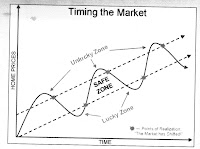 bit further, a couple of different things could happen. The market could stay the same, in which case you have thrown more rent money towards your landlord's mortgage instead of your own. The market could begin to rise, in which case you now scramble to buy (along with the others in your situation), and now find yourself in a much less powerful negotiating position. Or, in the ideal situation, the market drops another percent or even two. O.K., assuming a 2% drop, the $400,000 home is now $392,000.00. But you have spent money on rent during that time instead of paying down your mortgage for those few additional months, and what about paying yourself first? What about the stress of being "in limbo" for that much longer, not starting your new life in your new home? When you look at the affordability of that $8,000.00, with interest rates as low as they are now, you are talking about a little more than a dollar a day. For only a dollar a day more on your mortgage, you are going to put off making a move that will change your life for the better? You are going to put up with your cramped rental situation instead of moving to your dream home FOR A BUCK A DAY!??? Or, for those trading up their home, (which is lacking some bells and whistles), for their dream home, how much money are you really saving by waiting? Any savings on the home you are buying is also being sucked out of your equity in your current home as the market falls.
The bottom line is this: If you find a home that meets all or most of your criteria, that is in your price range, and it feels like a home in which you would be happy, BUY IT! Don't put it off waiting for the market to do what there are no guarantees it will do. Your dream home may not wait for you. Selection is very high now, in this buyer's market. You have a better chance of finding a suitable home now than you will once the market starts its correction. Start living now! You and I have no idea when the prices are going to start climbing back up again. There are already signs of life in the Fraser Valley Real estate market. The statistics I just viewed from the FVREB are as follows:
March 31, 2009: listings 3028, sales 1008
February 27, 2009: listings 2369, sales 682
March 31, 2008: listings 3278, sales 1317
So, as you can see, the sales activity from February to March has increased significantly, and is not far behind the 2008 numbers. The listings are actually down from March 2008 over 2009, so that creates pressure on prices as inventory levels drop (supply and demand).
This is one of the most affordable times to buy that we have seen in many years. Don't miss the boat!
I can help you to make your dreams come true. Call me to help you make the most important decision of your life an INFORMED decision.
Ironically, with prices having come down significantly over the past year, and interest rates amazingly low, increasing affordability by leaps and bounds, there seems to be no urgency for the remaining first-time buyers to buy. But truly, now IS a great time to buy.
There seems to be a prevailing opinion among buyers that prices will continue to fall for some time. That may or may not be true. The problem with this thinking is that there is always a lag period between when the market actually starts to correct, and when it is obvious (to everyone) that the recovery has begun. (See graph). By the time that it is obvious to everyone, you will not only have lost some of your "price erosion savings", but you will lose your negotiating power.
If you are investing in real estate for the long-term (i.e. this is to be your family home for a few years to come), trying to time the bottom of the market is more or less irrelevant. If, for example, you continue to rent a few more months, while waiting for the market to drop a
 bit further, a couple of different things could happen. The market could stay the same, in which case you have thrown more rent money towards your landlord's mortgage instead of your own. The market could begin to rise, in which case you now scramble to buy (along with the others in your situation), and now find yourself in a much less powerful negotiating position. Or, in the ideal situation, the market drops another percent or even two. O.K., assuming a 2% drop, the $400,000 home is now $392,000.00. But you have spent money on rent during that time instead of paying down your mortgage for those few additional months, and what about paying yourself first? What about the stress of being "in limbo" for that much longer, not starting your new life in your new home? When you look at the affordability of that $8,000.00, with interest rates as low as they are now, you are talking about a little more than a dollar a day. For only a dollar a day more on your mortgage, you are going to put off making a move that will change your life for the better? You are going to put up with your cramped rental situation instead of moving to your dream home FOR A BUCK A DAY!??? Or, for those trading up their home, (which is lacking some bells and whistles), for their dream home, how much money are you really saving by waiting? Any savings on the home you are buying is also being sucked out of your equity in your current home as the market falls.
The bottom line is this: If you find a home that meets all or most of your criteria, that is in your price range, and it feels like a home in which you would be happy, BUY IT! Don't put it off waiting for the market to do what there are no guarantees it will do. Your dream home may not wait for you. Selection is very high now, in this buyer's market. You have a better chance of finding a suitable home now than you will once the market starts its correction. Start living now! You and I have no idea when the prices are going to start climbing back up again. There are already signs of life in the Fraser Valley Real estate market. The statistics I just viewed from the FVREB are as follows:
March 31, 2009: listings 3028, sales 1008
February 27, 2009: listings 2369, sales 682
March 31, 2008: listings 3278, sales 1317
So, as you can see, the sales activity from February to March has increased significantly, and is not far behind the 2008 numbers. The listings are actually down from March 2008 over 2009, so that creates pressure on prices as inventory levels drop (supply and demand).
This is one of the most affordable times to buy that we have seen in many years. Don't miss the boat!
I can help you to make your dreams come true. Call me to help you make the most important decision of your life an INFORMED decision.


Tuesday, October 7, 2008
Housing Market Update
I just read a very sound report from Scotiabank Group titled "Special Update: Canadian Mortgages". It supports what was reported on the local news last week. The newscasters had interviewed Cameron Muir from the BCREA and a couple of local Realtors. One of the conclusions was that prices have dropped about 5% so far in the last six months, and we may expect up to the same amount again over the next 6 months to a year. The Scotiabank Group report speaks of "further fairly modest erosion of house prices." So, without putting a number on it, they are saying that prices will continue to decline a little bit for the next little while.
While I do not have a crystal ball to predict the future, I am presently of the opinion that a lot of the price drops in the last six months have been due to the fear factor, not sound economics. No one really knows how much the U.S. slowdown will affect our economy and Buyers are afraid to make the wrong decision. Perhaps they are afraid to buy a first home before the market bottom comes, thus paying too much, or afraid to get a mortgage on a home and then lose their income. So, a lot of people are in the "wait and see" mindset. The activity that we continue to experience in the market is from people who are not easily scared off by the media hype, or people who cannot afford to wait due to a change in their circumstances.
With the bailout package in the U.S. having just been put in place, it will take some time to see how much success it has to rescue the U.S. from a serious recession, or even a depression. Depending on the severity of the problems in the U.S., B.C. may not see much of a decline in the economy, since our economy is in some ways more insulated from the U.S. effect (due to fewer manufacturing jobs, more exports to Asia). We will definitely fare better than many other Canadian provinces will.
I believe that there are only two changes that are possible come the spring - either it will become clear that our economy has definitely declined and many people are losing their jobs, which will cause house prices to drop even further, or people will start to realize that our economy will weather this storm, and housing prices will start to rebound. I am optimistic that prices will rebound sooner, rather than later.
I believe that much of the media hype is just that - "hype" - and that time will tell how much our economy will withstand this. I believe that prices are not going to erode for very long, and agree with the experts that price drops will be slow and gradual.
For buyers there are still many reasons that now is the right time to buy. If they sit and wait, they may have less selection, and in the mean time, how many rent payments will they have thrown away? There are many homes that are fantastic steals due to divorces or job transfers forcing a quick sale, and there are definitely many deals to be had in this strong buyers' market. The options and inventory are abundant, so finding your dream home, with all the options and features that you want, is easier than it has been in years.
Also, for sellers, now is a great time to make an upward move, or perhaps to shorten your commute. If you have been wanting that extra bedroom or that larger lot, or to move closer to Vancouver, you can't lose right now. Any declines in your home's value have most likely been more than offset by the declines in the price of the bigger home, or the one closer to town.
Also, in a strong sellers' market, many sellers were tempted to buy first - writing an offer subject to the sale of their home. This is not a recommended practice because it generally costs you more money overall, but many people do it so they ensure they won't end up with nothing appropriate to buy, (with the slim pickings of a seller's market), and to be forced to rent until something appropriate comes available, meaning they have to move twice. With the buyers' market we are in, you can be sure that with the inventory levels we currently have, only the pickiest people will be hard-pressed to find a suitable home to buy. That leaves you free to sell your home before making an offer on a home to purchase, keeping more money in your pockets.
If I can be of service to you in the Mission or Abbotsford area, or if you need a referral to one of my colleagues in your area, please do not hesitate to contact me. My information is in the side panel. Have a safe and happy October!
While I do not have a crystal ball to predict the future, I am presently of the opinion that a lot of the price drops in the last six months have been due to the fear factor, not sound economics. No one really knows how much the U.S. slowdown will affect our economy and Buyers are afraid to make the wrong decision. Perhaps they are afraid to buy a first home before the market bottom comes, thus paying too much, or afraid to get a mortgage on a home and then lose their income. So, a lot of people are in the "wait and see" mindset. The activity that we continue to experience in the market is from people who are not easily scared off by the media hype, or people who cannot afford to wait due to a change in their circumstances.
With the bailout package in the U.S. having just been put in place, it will take some time to see how much success it has to rescue the U.S. from a serious recession, or even a depression. Depending on the severity of the problems in the U.S., B.C. may not see much of a decline in the economy, since our economy is in some ways more insulated from the U.S. effect (due to fewer manufacturing jobs, more exports to Asia). We will definitely fare better than many other Canadian provinces will.
I believe that there are only two changes that are possible come the spring - either it will become clear that our economy has definitely declined and many people are losing their jobs, which will cause house prices to drop even further, or people will start to realize that our economy will weather this storm, and housing prices will start to rebound. I am optimistic that prices will rebound sooner, rather than later.
I believe that much of the media hype is just that - "hype" - and that time will tell how much our economy will withstand this. I believe that prices are not going to erode for very long, and agree with the experts that price drops will be slow and gradual.
For buyers there are still many reasons that now is the right time to buy. If they sit and wait, they may have less selection, and in the mean time, how many rent payments will they have thrown away? There are many homes that are fantastic steals due to divorces or job transfers forcing a quick sale, and there are definitely many deals to be had in this strong buyers' market. The options and inventory are abundant, so finding your dream home, with all the options and features that you want, is easier than it has been in years.
Also, for sellers, now is a great time to make an upward move, or perhaps to shorten your commute. If you have been wanting that extra bedroom or that larger lot, or to move closer to Vancouver, you can't lose right now. Any declines in your home's value have most likely been more than offset by the declines in the price of the bigger home, or the one closer to town.
Also, in a strong sellers' market, many sellers were tempted to buy first - writing an offer subject to the sale of their home. This is not a recommended practice because it generally costs you more money overall, but many people do it so they ensure they won't end up with nothing appropriate to buy, (with the slim pickings of a seller's market), and to be forced to rent until something appropriate comes available, meaning they have to move twice. With the buyers' market we are in, you can be sure that with the inventory levels we currently have, only the pickiest people will be hard-pressed to find a suitable home to buy. That leaves you free to sell your home before making an offer on a home to purchase, keeping more money in your pockets.
If I can be of service to you in the Mission or Abbotsford area, or if you need a referral to one of my colleagues in your area, please do not hesitate to contact me. My information is in the side panel. Have a safe and happy October!
Thursday, July 17, 2008
A Market Shift = A Shift In Expectations
Market conditions have shifted. After five years of blockbuster activity and double-digit price growth, market conditions have slowed, and now favour buyers in many areas of the province.
Residential sales have declined 22 per cent in the first six months of this year, while available resale inventory has grown by 54 per cent to 57,000 active listings in June. In the Greater Vancouver board area, where longer-term data is available, inventory is at the highest level since 1998.
Home price appreciation observed from 2004 to 2007 is less attainable in today’s market, and sellers’ expectations for such gains should be tempered. More generally, in a market favouring buyers, prices generally increase at or below the level of inflation. While the average residential home price in BC increased at a healthy 6 per cent per year since 1981, large gains are often followed by periods of price stagnation. Over-optimistic pricing by sellers will only inhibit the timely sale of properties, adding to inventory levels.
Buyers have more homes to choose from now than in previous years, resulting in greater freedom to compare the attributes and prices of similar properties in the market before making purchase decisions.
Despite current buyers' market conditions fuelled by housing affordability constraints and economic uncertainty, the economic and demographic backdrop in support of housing demand remains strong in BC. BC's unemployment rate remains near record lows, while the labour force participation rate hovers near historical highs. Meanwhile, the province remains a favoured destination for new migrants, reflected in the third-highest population growth among provinces during the first quarter of 2008. However, challenges continue in the forestry sector, and eroded consumer confidence may also be playing a role in a pull back of consumer spending.
Copyright British Columbia Real Estate Association. Reprinted with permission. BCREA makes no guarantees as to the accuracy or completeness of this information.
Residential sales have declined 22 per cent in the first six months of this year, while available resale inventory has grown by 54 per cent to 57,000 active listings in June. In the Greater Vancouver board area, where longer-term data is available, inventory is at the highest level since 1998.
Home price appreciation observed from 2004 to 2007 is less attainable in today’s market, and sellers’ expectations for such gains should be tempered. More generally, in a market favouring buyers, prices generally increase at or below the level of inflation. While the average residential home price in BC increased at a healthy 6 per cent per year since 1981, large gains are often followed by periods of price stagnation. Over-optimistic pricing by sellers will only inhibit the timely sale of properties, adding to inventory levels.
Buyers have more homes to choose from now than in previous years, resulting in greater freedom to compare the attributes and prices of similar properties in the market before making purchase decisions.
Despite current buyers' market conditions fuelled by housing affordability constraints and economic uncertainty, the economic and demographic backdrop in support of housing demand remains strong in BC. BC's unemployment rate remains near record lows, while the labour force participation rate hovers near historical highs. Meanwhile, the province remains a favoured destination for new migrants, reflected in the third-highest population growth among provinces during the first quarter of 2008. However, challenges continue in the forestry sector, and eroded consumer confidence may also be playing a role in a pull back of consumer spending.
Copyright British Columbia Real Estate Association. Reprinted with permission. BCREA makes no guarantees as to the accuracy or completeness of this information.
Monday, July 14, 2008
Ottawa Tightens Mortgage Rules
Wednesday, July 9th, 2008 CBC News
The federal government said Wednesday that it is tightening the rules relating to government- guaranteed mortgages, even though there is no evidence that the Canadian market is facing the kind of turmoil that has disrupted the United States.
The new rules, set to take effect Oct. 15, are a "responsible and measured approach … to reduce the risk of a U.S.-style housing bubble developing in Canada," the Department of Finance said in a news release.
However, it also said that Canadian creditors' "prudent and cautious approach" to mortgage lending, as well as sound supervision, have "allowed Canada to maintain strong and secure housing and mortgage markets."
The government said the measures will apply to new, government-backed, insured mortgages. "Canadians who already hold mortgages will not be affected," it said.
The changes include:
Cutting the maximum amortization period to 35 years from 40.
Requiring a minimum down payment of five per cent, whereas loans for 100 per cent of the price are possible now.
Establishing a requirement for a consistent minimum credit score.
Introducing new loan-documentation standards.
The government acknowledged that the proportion of bank mortgages in arrears is stable at 0.27 per cent, "near the lowest levels experienced since 1990 and well below the highs of 0.65 per cent experienced in each of 1992 and 1997."
And housing prices don't show evidence of speculation, the Finance Department said, because they are "in line with economic factors such as low interest rates, rising incomes and a growing population."
Mortgage insurance protects lenders when a borrower defaults by making up any shortfall needed to repay the loan if the sale of the property doesn't cover the debt.
Federally regulated lenders must have mortgage insurance on loans where the buyer's down payment is less than 20 per cent of the price.
The Canada Mortgage and Housing Corp. (CMHC), a Crown corporation, as well as private insurers provide mortgage insurance. The government backs CMHC and also private mortgage insurers so the private insurers can compete with CMHC.
Just over a year ago, Parliament passed a bill changing mortgage insurance to make home buying easier, and in 2006, CMHC eased the insurance rules.
The federal government said Wednesday that it is tightening the rules relating to government- guaranteed mortgages, even though there is no evidence that the Canadian market is facing the kind of turmoil that has disrupted the United States.
The new rules, set to take effect Oct. 15, are a "responsible and measured approach … to reduce the risk of a U.S.-style housing bubble developing in Canada," the Department of Finance said in a news release.
However, it also said that Canadian creditors' "prudent and cautious approach" to mortgage lending, as well as sound supervision, have "allowed Canada to maintain strong and secure housing and mortgage markets."
The government said the measures will apply to new, government-backed, insured mortgages. "Canadians who already hold mortgages will not be affected," it said.
The changes include:
Cutting the maximum amortization period to 35 years from 40.
Requiring a minimum down payment of five per cent, whereas loans for 100 per cent of the price are possible now.
Establishing a requirement for a consistent minimum credit score.
Introducing new loan-documentation standards.
The government acknowledged that the proportion of bank mortgages in arrears is stable at 0.27 per cent, "near the lowest levels experienced since 1990 and well below the highs of 0.65 per cent experienced in each of 1992 and 1997."
And housing prices don't show evidence of speculation, the Finance Department said, because they are "in line with economic factors such as low interest rates, rising incomes and a growing population."
Mortgage insurance protects lenders when a borrower defaults by making up any shortfall needed to repay the loan if the sale of the property doesn't cover the debt.
Federally regulated lenders must have mortgage insurance on loans where the buyer's down payment is less than 20 per cent of the price.
The Canada Mortgage and Housing Corp. (CMHC), a Crown corporation, as well as private insurers provide mortgage insurance. The government backs CMHC and also private mortgage insurers so the private insurers can compete with CMHC.
Just over a year ago, Parliament passed a bill changing mortgage insurance to make home buying easier, and in 2006, CMHC eased the insurance rules.
Thursday, July 3, 2008
Housing Market Update
The latest US Unemployment rate held steady last month at 5.50%, however; year to date they have lost 438,000 jobs. Their Housing Crisis is not over and you can expect more gloomy news over the next few months.
Canada had some good news in April, reporting modest Economic growth. This gives us some hope that Canada will avoid a Recession. In Europe, the Central Bank recently increased interest rates by a quarter point to ensure their Inflation stays in control.
The Western provinces of Canada have much different economies than in the Eastern provinces, and at this point in time are in a good position to weather the surrounding economic storms quite nicely. That should translate to our housing markets in the West staying stronger than in the East, as our unemployment levels remain at extremely low levels, thus bolstering consumer confidence.
In the June 27, 2008 Real Estate Weekly for Mission, it was noted that the Canada Mortgage and Housing Corporation said that the seasonally adjusted annual rate of housing starts rose 3.5 per cent to 221,300 units in May from 213,900 in April. It attributed the increase to a rise in single-family home starts, which in April had reached their lowest level since May 2001. BMO economist, Doug Porter, was quoted to have said "It just shows that things are not deteriorating rapidly and continue to not disappoint: The Canadian housing market, after all, is still holding up relatively well." But he also noted that he believes there will be some slowdown in activity later this year.
The CMHC is forecasting around 214,000 to 215,000 home starts for 2008, as rising incomes, low unemployment and low mortgage rates boost home ownership. This number is slightly down from 2007, but still strong by historical standards. Economist Pascal Gauthier notes anything above 200,000 is fairly robust. "There's nothing that suggests construction activity is going to come off the tracks," Gauthier said. "It is really just a gradual cooling."
If you are considering a Real Estate move this year, I would be happy to offer a second opinion about your decision, with relation to what the market is currently doing. Feel free to give me a call or drop me an e-mail at the contact information noted on this page.
Best regards, Cyndi Polovina
Canada had some good news in April, reporting modest Economic growth. This gives us some hope that Canada will avoid a Recession. In Europe, the Central Bank recently increased interest rates by a quarter point to ensure their Inflation stays in control.
The Western provinces of Canada have much different economies than in the Eastern provinces, and at this point in time are in a good position to weather the surrounding economic storms quite nicely. That should translate to our housing markets in the West staying stronger than in the East, as our unemployment levels remain at extremely low levels, thus bolstering consumer confidence.
In the June 27, 2008 Real Estate Weekly for Mission, it was noted that the Canada Mortgage and Housing Corporation said that the seasonally adjusted annual rate of housing starts rose 3.5 per cent to 221,300 units in May from 213,900 in April. It attributed the increase to a rise in single-family home starts, which in April had reached their lowest level since May 2001. BMO economist, Doug Porter, was quoted to have said "It just shows that things are not deteriorating rapidly and continue to not disappoint: The Canadian housing market, after all, is still holding up relatively well." But he also noted that he believes there will be some slowdown in activity later this year.
The CMHC is forecasting around 214,000 to 215,000 home starts for 2008, as rising incomes, low unemployment and low mortgage rates boost home ownership. This number is slightly down from 2007, but still strong by historical standards. Economist Pascal Gauthier notes anything above 200,000 is fairly robust. "There's nothing that suggests construction activity is going to come off the tracks," Gauthier said. "It is really just a gradual cooling."
If you are considering a Real Estate move this year, I would be happy to offer a second opinion about your decision, with relation to what the market is currently doing. Feel free to give me a call or drop me an e-mail at the contact information noted on this page.
Best regards, Cyndi Polovina
Subscribe to:
Posts (Atom)